
Renewing driver’s license in Japan, Saitama style
In Japan, a driver’s license is usually valid for five years. That means, every five years, we have to go through the renewal process, with the deadline set on the license holder’s fifth birthday.
A few days ago, I received the renewal notice from Saitama Prefectural Police.
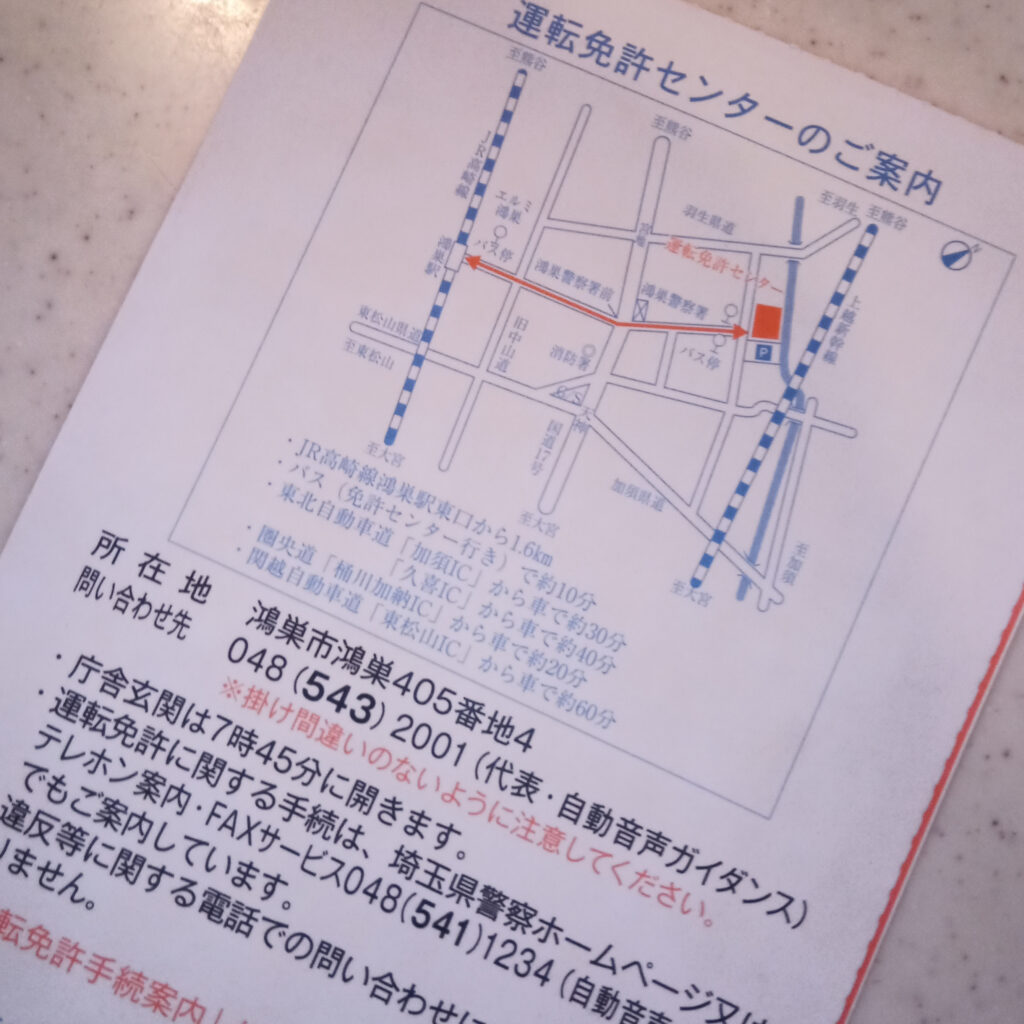
When I flipped the postcard over and saw the map on the back, I felt a small jolt of fear. According to it, I might have to go all the way to the main “licensing center” in Kōnosu City, in Saitama Prefecture.
Typically, each prefecture has only one such “licensing center.” If you live far from it, that can easily mean an hour or more of travel each way just to renew your license. Kōnosu sits more or less in the geographic center of Saitama, but for those of us living in the southern part of the prefecture, it feels quite far away. Since most people in Saitama live in the south, largely because of its proximity to central Tokyo, going to Kōnosu inevitably turns into a bit of a journey.
It’s pretty unreasonable. But at the same time, it may also function as a kind of “soft law”: behave yourself for five years and you’re rewarded with the convenience of renewing your license at a nearby police station. Get caught committing an infraction, and you’re sent to the distant central facility.
I was fairly sure I hadn’t been caught doing anything over the past five years… so I opened the postcard, slightly nervously…
…and discovered that I can renew my license at my local station. Relief.
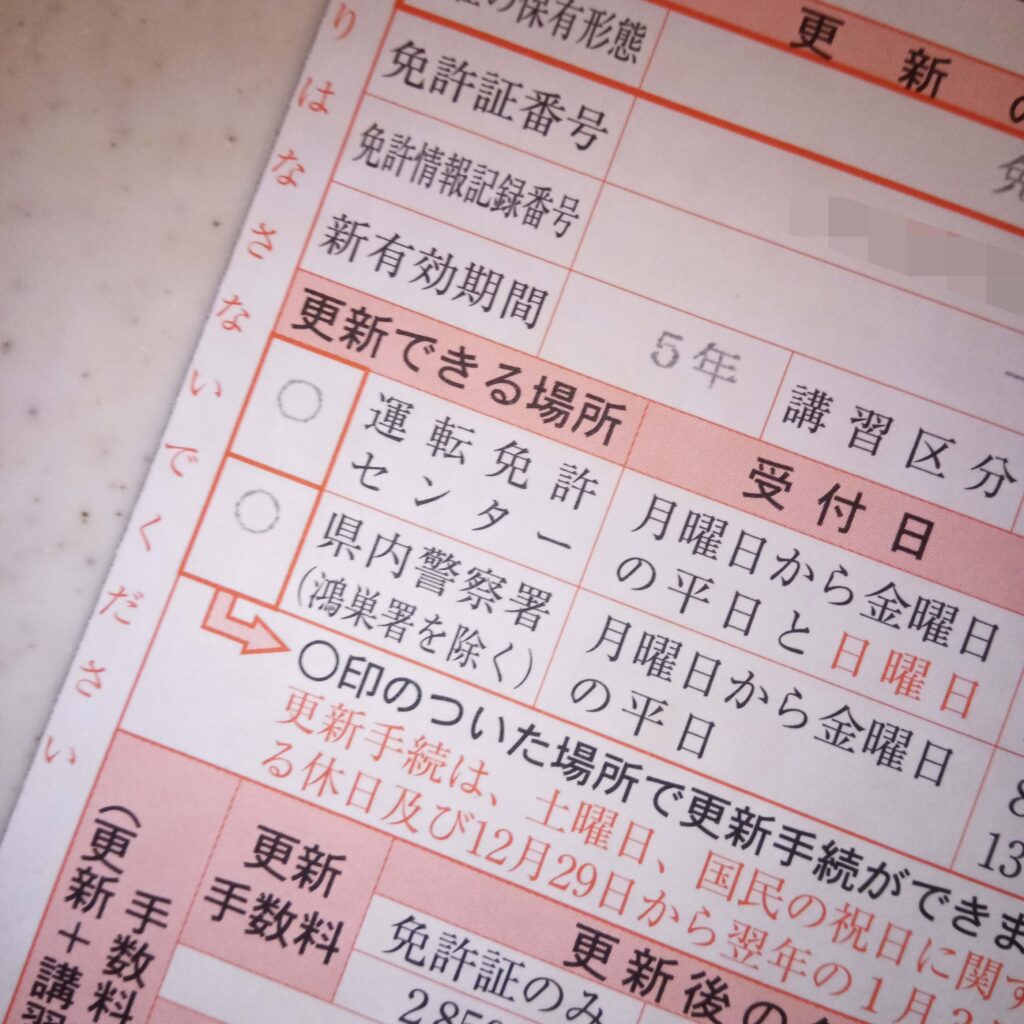
These days, it’s also possible to merge your driver’s license with Japan’s My Number (“Myna”) card. In theory, that sounds modern and convenient. In practice, though, the benefits seem minimal. The fee is a bit cheaper, but the process takes longer than simply having a conventional license card printed. Which basically means spending extra time sitting around at a police station, not exactly everyone’s idea of efficiency.
Anyway, I’m glad I don’t have to make the long trip to Kōnosu, more than an hour away from home. Still, part of me thinks that a day trip to the northern part of the prefecture might not have been so bad… a bowl of local udon noodle, a change of scenery, and a short break from the usual busy routine.
2026/01/10 9:39 PM - Tweet
Soba-gara: Sustainability Woven into Every Night
Lately, I’ve been waking up with an unfamiliar pain in my neck. After a few mornings of the same discomfort, it turns out that the pain was triggered by my pillow which had lost its height. What had once provided firm support had gradually flattened, no longer keeping my neck in a comfortable position through the night.
The pillow in question is filled with soba-gara (in Japanese), meaning buckwheat seed shells. Historically, this was the most conventional pillow material in Japan. Today, however, soba-gara pillows are becoming old-fashioned in an era dominated by memory foam and synthetic fibers.
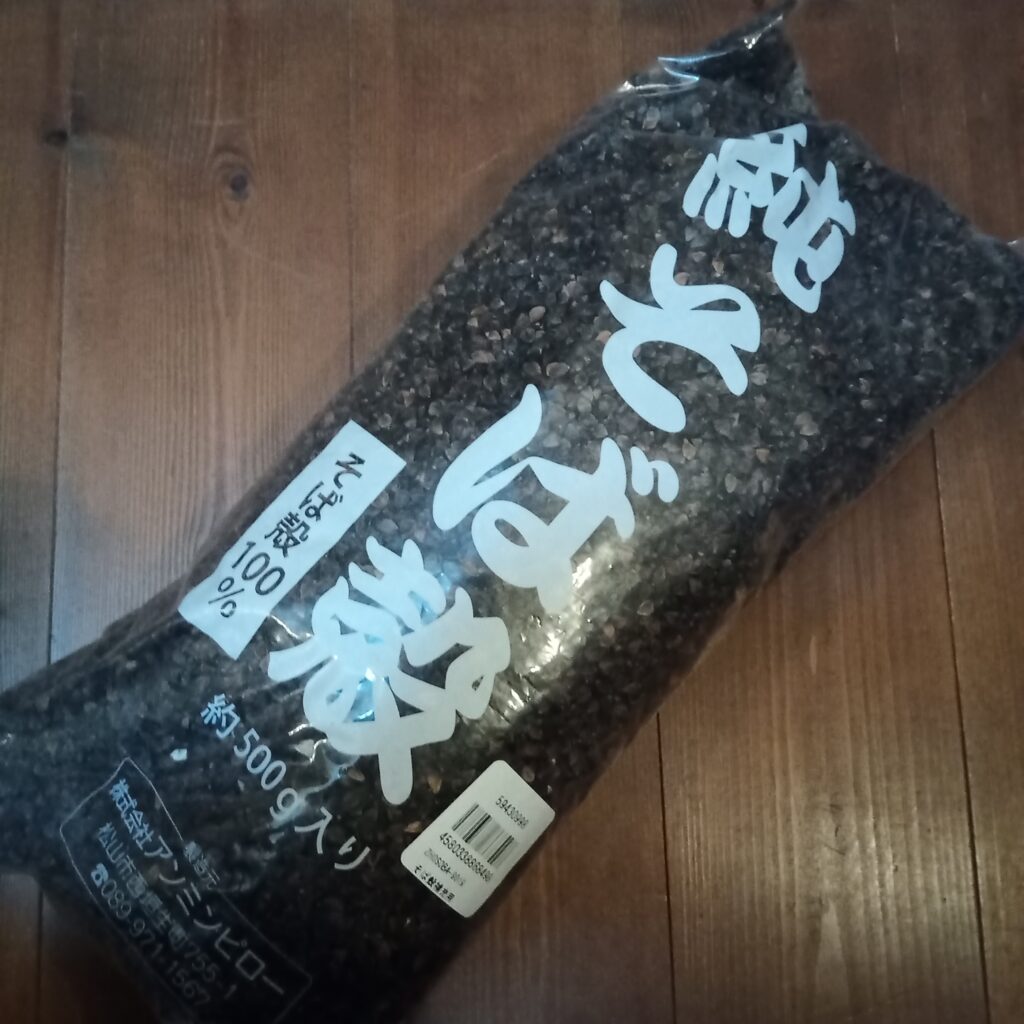
Soba-gara is a byproduct of food production. When buckwheat is processed to make our soba noodles, the hard outer shells must be removed before milling. Rather than discarding this material, Japanese households have long reused it as pillow filling. Long before terms like “upcycling” or “circular economy” became popular, this was simply an ordinary way of making practical use of what was available.
That practicality, however, comes with a trade-off. Buckwheat shells are durable but not permanent. Night after night, the weight of one’s head slowly crushes them into smaller fragments. Over time, the pillow compresses, losing volume and support.
Today, I refilled the pillow with fresh soba-gara. Replacement shells are still sold, though they are a bit hard to find. I eventually located them at a local Super Viva-Home, a large Japanese home-improvement store comparable to Home Depot. The act of refilling is a reminder that some household items are meant to be maintained, rather than replaced.
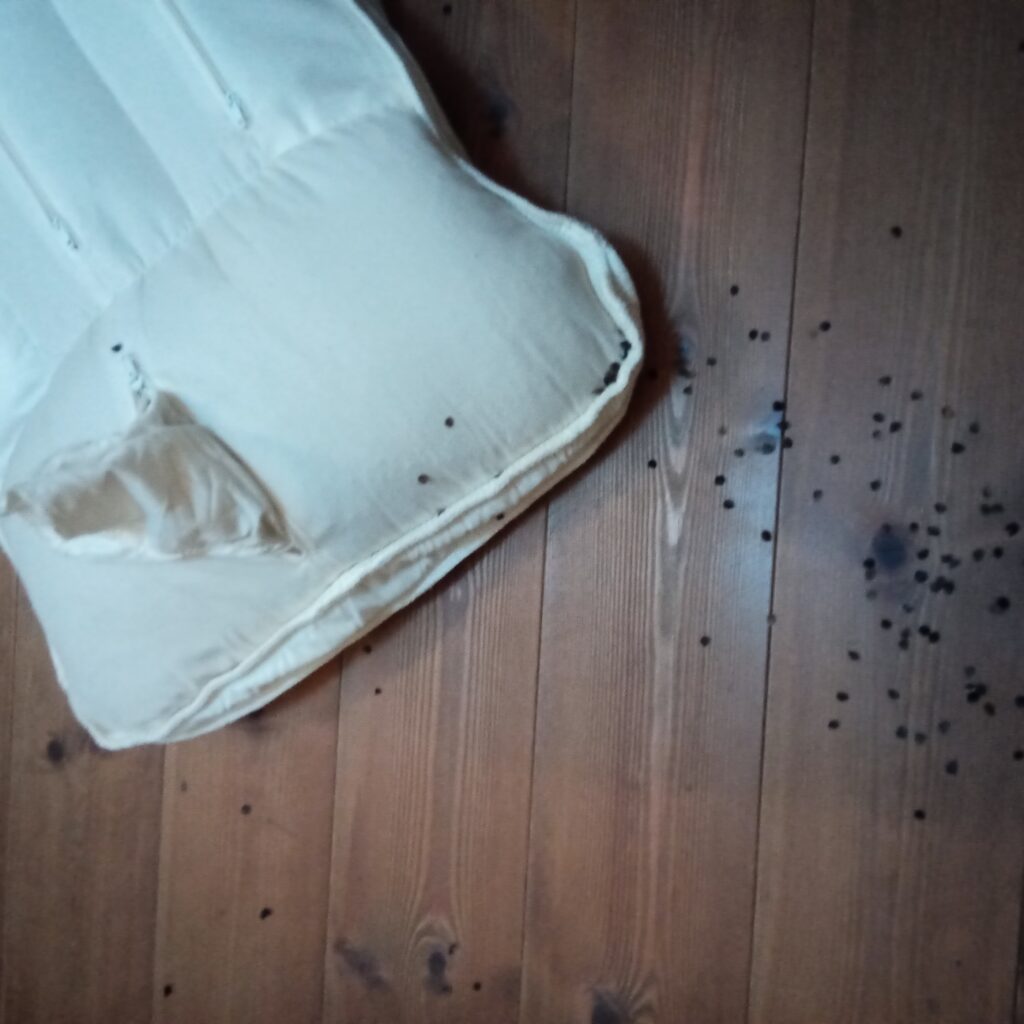
The pillow itself was purchased at Nitori, a major Japanese home-furnishing chain. This one has four separate compartments, each filled with soba-gara. The design allows an adjustment of height and shape, accommodating individual sleeping preferences.
With the pillow refilled, I’m hoping tomorrow morning will be gentler on my neck, thanks to this traditional and entirely natural way of keeping my head supported.
2026/01/05 2:03 PM - Tweet