
Renewing driver’s license in Japan, Saitama style
In Japan, a driver’s license is usually valid for five years. That means, every five years, we have to go through the renewal process, with the deadline set on the license holder’s fifth birthday.
A few days ago, I received the renewal notice from Saitama Prefectural Police.
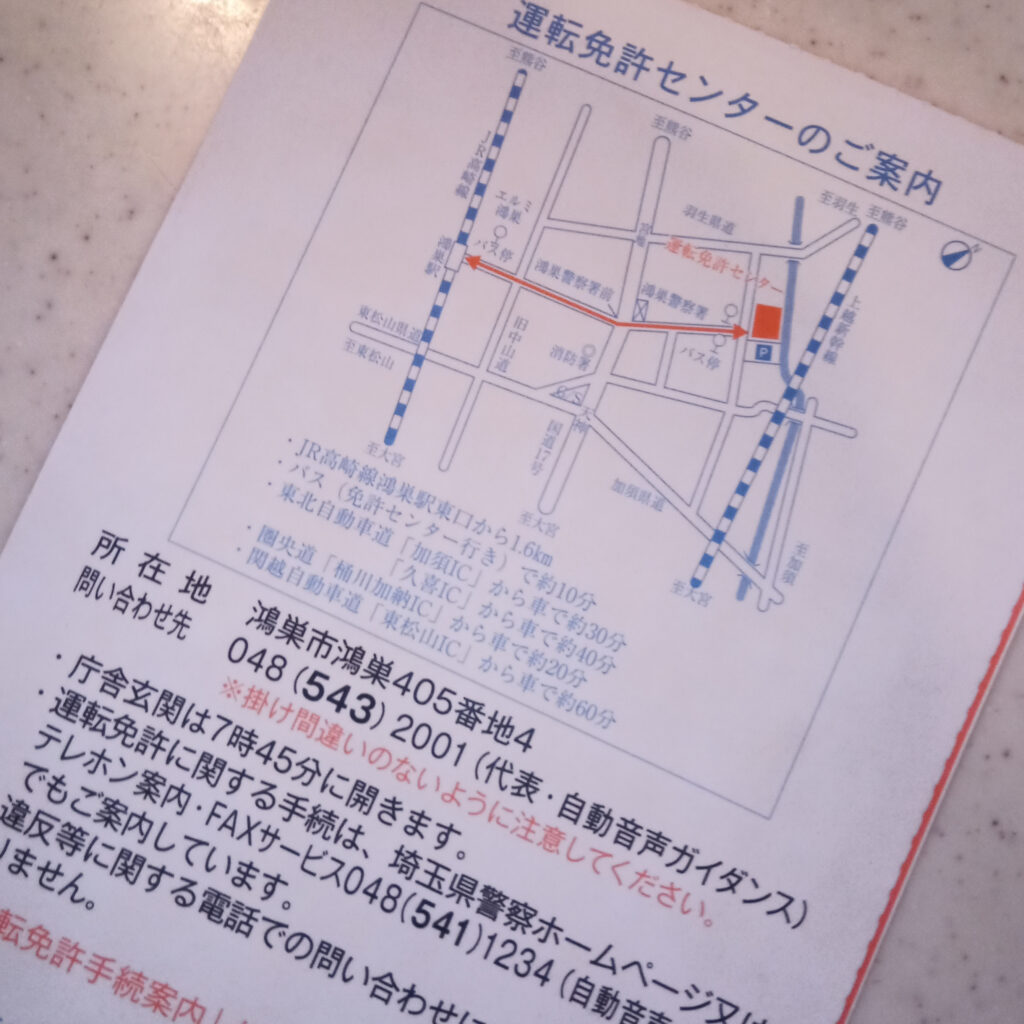
When I flipped the postcard over and saw the map on the back, I felt a small jolt of fear. According to it, I might have to go all the way to the main “licensing center” in Kōnosu City, in Saitama Prefecture.
Typically, each prefecture has only one such “licensing center.” If you live far from it, that can easily mean an hour or more of travel each way just to renew your license. Kōnosu sits more or less in the geographic center of Saitama, but for those of us living in the southern part of the prefecture, it feels quite far away. Since most people in Saitama live in the south, largely because of its proximity to central Tokyo, going to Kōnosu inevitably turns into a bit of a journey.
It’s pretty unreasonable. But at the same time, it may also function as a kind of “soft law”: behave yourself for five years and you’re rewarded with the convenience of renewing your license at a nearby police station. Get caught committing an infraction, and you’re sent to the distant central facility.
I was fairly sure I hadn’t been caught doing anything over the past five years… so I opened the postcard, slightly nervously…
…and discovered that I can renew my license at my local station. Relief.
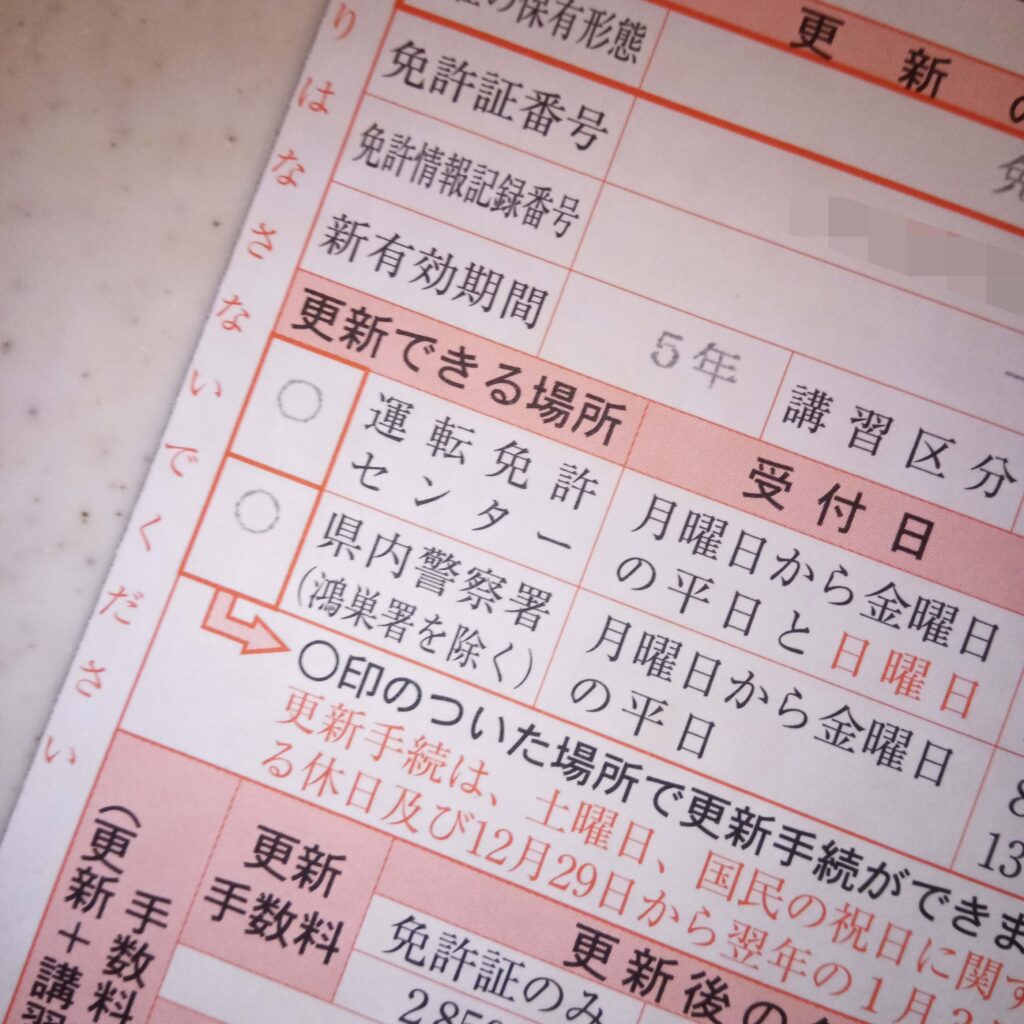
These days, it’s also possible to merge your driver’s license with Japan’s My Number (“Myna”) card. In theory, that sounds modern and convenient. In practice, though, the benefits seem minimal. The fee is a bit cheaper, but the process takes longer than simply having a conventional license card printed. Which basically means spending extra time sitting around at a police station, not exactly everyone’s idea of efficiency.
Anyway, I’m glad I don’t have to make the long trip to Kōnosu, more than an hour away from home. Still, part of me thinks that a day trip to the northern part of the prefecture might not have been so bad… a bowl of local udon noodle, a change of scenery, and a short break from the usual busy routine.
2026/01/10 9:39 PM - Tweet
Japan-made electric buses in a world that has already moved on
A local bus company in Fukushima Prefecture has begun introducing 30 electric buses as part of an “experimental” project subsidized by the national government. According to a news report, three of the vehicles are already in operation.
福島交通がEVバス導入 大槻営業所を専用運行拠点に:福島ニュース:福島民友新聞社
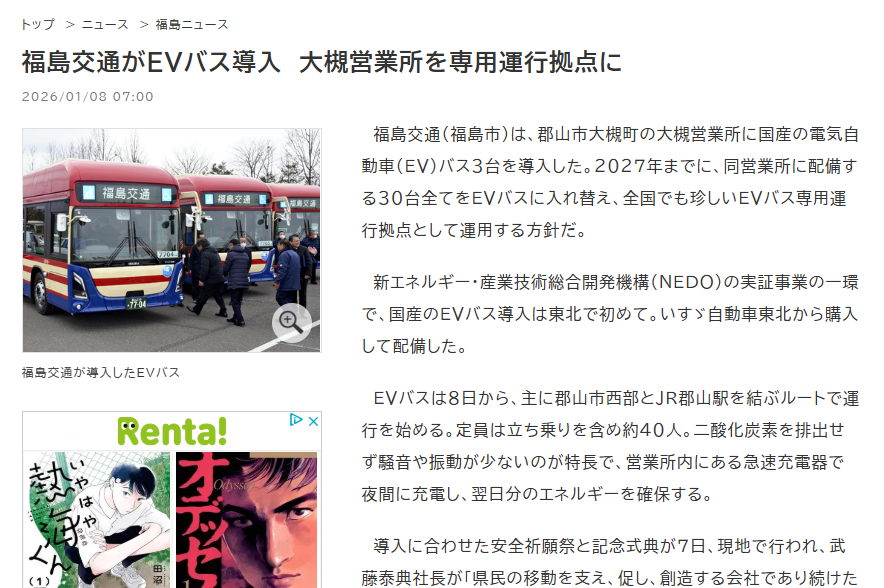
One point the article seems to emphasize is that these buses are “made in Japan” (kokusan).
This emphasis is understandable. Last year, several China-made electric buses caused a number of problems, particularly around the Osaka Expo site, and they gained a somewhat notorious reputation as a result. In that context, the “made in Japan” label may help ease passengers’ concerns.
The buses appear to be Isuzu’s Erga EV.
Based on information available on the manufacturer’s website, the vehicle has a stated range of about 360 km, though this figure assumes a constant speed of 30 km/h, which is not exactly realistic for daily urban operations. In terms of size and exterior design, the bus looks fairly conventional. Charging is supported via a plug-in connector with a maximum output of 50 kW.
When compared with electric buses already in service in other cities, particularly in Europe, this does not feel especially impressive. Many European systems have moved toward faster and more flexible charging solutions. According to the Fukushima report, these buses need to be charged overnight to cover a day’s operation. In practical terms, that likely limits each vehicle to well under 300 km per day.
To be clear, I am not arguing that China-made buses are better. Still, it is a bit disappointing to see that Japanese-made electric buses do not stand out more in terms of technological ambition or innovation. Another experiment reported in Kawasaki is expected to introduce pantograph-based super-charging systems, but even those have already been deployed at scale in other countries.
I sincerely hope that Japanese bus manufacturers will take a further step: one that truly surprises the world, rather than merely catching up with what has already become standard elsewhere.
2026/01/08 9:24 AM - Tweet